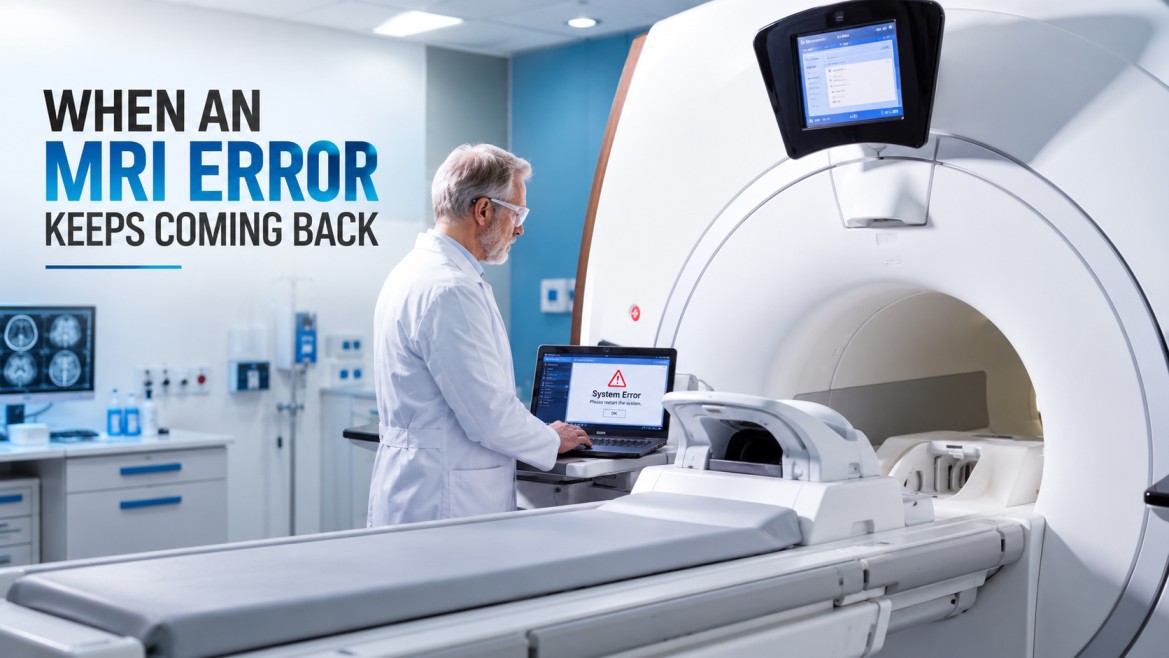
A recurrent MRI issue is never as simple as it appears. The machine goes back to normal after a reboot, it runs fine for a few days and no one thinks much about it. Nevertheless, if the same error keeps occurring, the hospital must stop treating it like an anomaly and start thinking of a reliable MRI Machine Repairing Service Maharashtra . In such cases, the professional repairing service should be able to identify patterns and resolve them, not just clear the message and leave.
The pattern of repeated errors usually indicates some underlying issues within the system, such as a faulty coil, improper cooling, a power supply problem, a software bug, a connection error, image quality concerns, or something else. The longer the pattern persists, the more serious the problem is, and the more downtime it can cause.
One Error Is Different From The Same Error Every Week
An isolated system message does not necessarily mean something catastrophic has occurred. Sometimes equipment will throw a diagnostic warning simply due to transient circumstances.
The situation changes when a certain error becomes repeated
Say there is an MRI system that shuts down while performing a study, reboots back up to normal functioning, and then does it again three days later. The same problem recurs another time a week later. At this point, simply rebooting the system is no longer going to be a sufficient course of action.
The hospital should document what time the error occurred, what sequence was being used when it happened, which coil was attached at the time, and if there were any anomalous circumstances preceding the fault.
This information can help an MRI Machine Repairing Service Maharashtra team troubleshoot the problem more quickly
Image Artefacts Should Not Be Ignored
Not every MRI problem presents itself in the form of an error code.
Sometimes the first sign of trouble is an image that appears to be different from what is expected. Artefacts may only be present during certain studies, on a particular coil, or after the system has been operating for several hours.
This does not necessarily mean that a major service is required,
but repeated image-quality issues should be investigated.
Poor image quality leads to resubmissions, longer appointment times and puts additional strain on technologists. In a busy diagnostic centre, even a minor quality issue can cause significant disruptions to the schedule. The technical team should look at the timing of the artefact and see if there is a pattern
Coil Problems Can Look Small At First
MRI coils are located near the patient and are used repeatedly during the day, which can lead to problems with cables, connections, or individual coil windings over time
A coil failure may manifest itself in the following ways:
- Intermittent connection problems
- Loss of signal from individual channels
- Image artefacts
- Scan abortion
- Multiple requests to reconnect the coil
If the cause of the malfunction is eliminated by disconnecting and reconnecting the coil, the error may not be repeated, and the service technician can stop the search for the cause of the malfunction. However, if there is a recurrence of coil failures, this fact should prompt the MRI machine servicing company Maharashtra to inspect the coil and scanner electronics before attempting to replace the coil.
Intermittent Shutdowns Need A Wider System Check
A scanner that is shutting down occasionally can be challenging to troubleshoot, as it may appear fine when the engineer comes to take a look.
This is why service history is essential.
The issue could be related to the power supply, cooling, internal components, software, or any other number of factors, and the only way to be absolutely certain is to test the machine, which is something that a hospital should not attempt on their own.
Instead, a simple log should be kept with the following notes:
- The date and time of the fault occurrence,
- the error message, if any is displayed,
- the type of scan being performed,
- the coil used,
- whether the machine rebooted itself or had to be manually reinitialized,
- the length of time the scanner was in use,
and any other abnormalities either the machine or the operator may have noticed.
This will give the engineer a far better idea of what may be going wrong than a vague description of the issue would.
When Should The Hospital Call For Service?
The real-world answer is – when the issue starts recurring.
If the same error, artefact, or interference happens several times in a row, it is no longer beneficial to wait for a full recurrence. This is especially true for high MRI-scanning facilities, where the occurrence of a minor malfunction can become an everyday headache as the number of procedures rises.
A fast MRI Machine Repairing Service Maharashtra can be one of the most critical investments a hospital can make. While faster response times are generally useful, an experienced team will be able to better address frequent issues. A minor software hiccup may leave the system non-functional for the day, but it may not necessarily stop it from happening again the next day.
Service History Becomes Important With Pre-Owned MRI Systems
Hospitals considering buying a used MRI scanner in Maharashtra should be guided by its service history.
An MRI machine that has been maintained well can offer better value even if it is older than another machine with a poor service history.
A buyer should thoroughly examine the service log of a machine they are considering purchasing. They should ask about the machine’s known faultiness, the condition of its coils, software issues, documentation, and spares availability. This is why a pre-owned MRI scanner should not be purchased solely on price.
How Bobby & Brother Approaches Recurring MRI Faults
At Bobby & Brother, recurring MRI issues present themselves as patterns needing to be investigated.
What is occurring around the fault, what component is involved, how frequently it recurs, and whether the fault impacts the quality of scans or uptime are all questions that must be asked.
For hospitals searching for MRI Machine Repairing Service Maharashtra or planning to Buy Refurbished MRI in Maharashtra, technical support should be a consideration at every step of the process.
A scanner may continue to work even with a minor fault present.
The question is how long a fault can be ignored before it needs to be resolved.
Final Thoughts
One MRI error does not always mean a significant system malfunction.
On the contrary, the same error constantly occurring should raise suspicion that something is going wrong.
Frequent shutdowns, coil malfunctions, image artifacts, repeated warnings, etc., must be checked and documented before major service issues arise.
In fact, a reputable MRI Machine Repairing Service Maharashtra provider should be able to look past the message and investigate the pattern that led to it.
After all, the best time to understand what is going on is right before the MRI machine breaks down completely.
Frequently Asked Questions
1. When Should A Repeated MRI Error Be Taken Seriously?
When the same error, shutdown, artefact, or coil issue appears more than once, especially if the frequency is increasing.
2. Can MRI Image Artefacts Be Caused By Equipment Problems?
Yes. Artefacts can come from several sources, including coils, connections, system settings, or equipment faults. Proper technical inspection is needed to identify the cause.
3. Should Staff Keep A Record Of MRI Errors?
Yes. Record the error code, time, scan type, coil used, and what happened before the fault. This can help engineers diagnose recurring problems faster.
4. Does A Recurring Coil Error Mean The Coil Must Be Replaced?
Not always. The problem may come from the coil, cable, connector, or system interface. Testing should come before replacement.
5. What Should Hospitals Check Before They Buy Refurbished MRI In Maharashtra?
Check service history, coil condition, software status, previous faults, parts availability, installation needs, and after-sales service support.
6. Why Is Local MRI Service Support Important In Maharashtra?
Local or regionally accessible service support can reduce response time and make repeat inspections easier when an intermittent problem needs ongoing diagnosis.